

During a routine service call on a vessel equipped with D8 Volvos, a significant and potentially dangerous customer complaint emerged- the port engine was displaying numerous fault codes, indicating a serious issue that required immediate attention.
As the technician meticulously inspected the engine, he unexpectedly felt a mild shock, a tingle of electricity. It was only when he removed his hand from the engine’s railing, or any metal part, that the sensation ceased, leading him to a startling realization-there was an electrical issue at play.
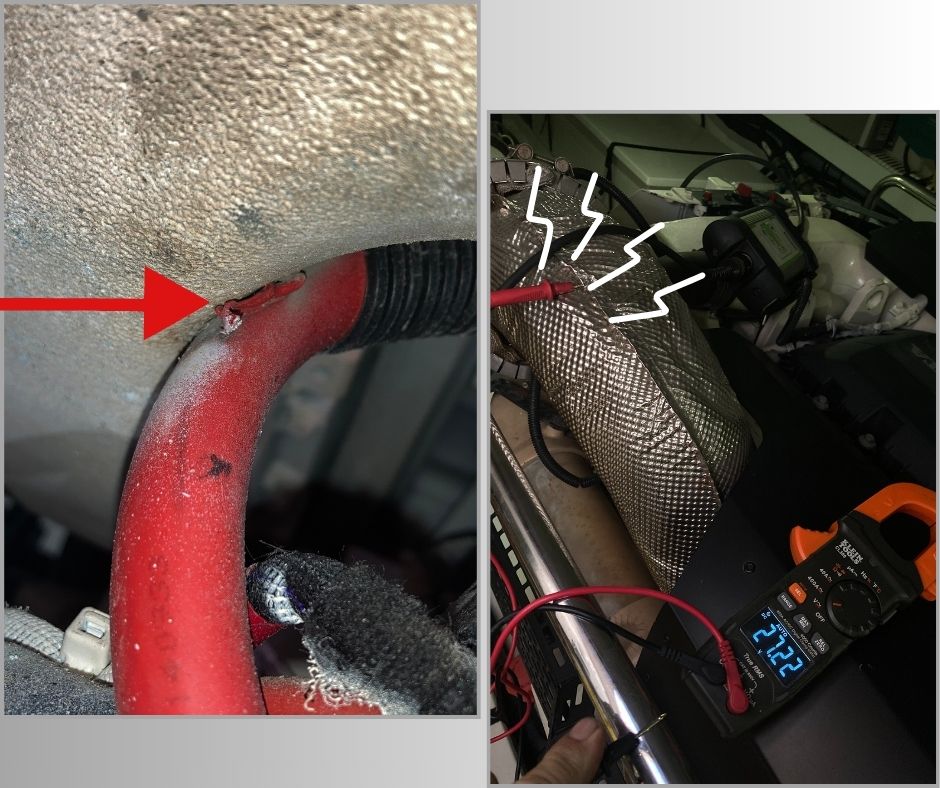
Taking out his multimeter, he touched the positive lead to the metal insulation on the exhaust riser while placing the ground lead on the stainless steel rail surrounding the engine.
The engine was “live” with 27.22 volts DC!
To ensure the vessel’s and its occupants’ safety, the tech had the customer turn off the battery switch to that engine while maintaining the leads. The voltage went away, eliminating the potential risk of electrical shock.
Tracing the positive battery leads from the battery box, it was found the cable had disappeared under a heat shield around the charge air piping. After removing the heat shield, the problem was obvious.
The Heavy gauge battery cable was touching the charge air piping, and insulation had melted off the wiring to the point that it was making contact.
Fortunately, this did not short out the batteries or cause other issues.
The Technician rerouted the cable from the engine and wrapped the bare spot in heat shrink tubing. The numerous codes were cleared for sensor voltages that were out of range and faults in that driveline’s ACP (Active Corr corrosion protection) system.
Problem Solved!
If you discover an unknown engine problem – seek advice from the experts! Contact Performance Power Systems to identify where the problem is coming from, and find a solution to your problem.
 Related posts




 Sign up for newsletter