

When it comes to maintaining Volvo Penta marine engines, minor issues in the exhaust system can create big performance problems. Recently, our Savannah branch was called to troubleshoot a 44’ Beneteau Swift Trawler equipped with Volvo Penta D4-300 engines. What seemed like a throttle lag turned into an important lesson in why turbo exhaust housings and risers should be inspected regularly.
Common Symptoms of Turbo Exhaust Issues
The vessel, a well-maintained 2014 model with 1,250 hours, was showing:
- Lag on acceleration in the starboard engine
- Both engines initially rising to 2,200–2,300 RPM and 10 psi boost
- Port engine surging to 3,000 RPM and 18–20 psi boost
- The starboard engine delayed, “catching up” only after ~30 seconds
- Final boost reaching 22–25 psi, slightly below rated performance
While fouled running gear and propeller condition could explain some performance loss, the lagging response on one engine raised concerns.
Troubleshooting the Usual Suspects
Our technician inspected all standard performance factors:
- Installed fresh fuel filters
- Reviewed data logs showing load, fuel pressure, and boost readings
- Checked for air inlet restrictions or leaks
- Inspected turbo compressor wheels (which spun freely)
The data was shared with Volvo Penta technical support, who recommended swapping the magnetic proportioning valves on the CP pumps. After a second service visit and testing, no significant change was noted.
The Hidden Culprit: Exhaust Restriction and Turbo Erosion
Thinking outside the box, our technician investigated exhaust back pressure—a common but often overlooked issue.
- A kink was discovered in the 4” exhaust hose leading to the water lift muffler.
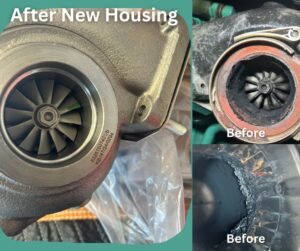
- Removal of the turbo exhaust riser revealed significant erosion in the cast iron housing, causing exhaust gases to bypass the turbine wheel.
- The stainless riser showed pinholes forming, which could eventually allow saltwater to backflow into the exhaust manifold—a serious risk for catastrophic marine engine damage.
Inspection of the port-side turbo and riser revealed the same early signs of deterioration.
Solution: Replacing Marine Turbos and Risers
Both remanufactured turbos and new risers were installed. After replacement:
- The vessel achieved over 30 psi boost
- RPM improved to near 3,300
- Acceleration lag was eliminated
The comparison between the old and new housings made it clear just how much performance was lost due to erosion and exhaust restriction.
Why Turbo Exhaust Housings and Risers Fail
Even well-maintained marine diesel engines are vulnerable. Humid salt air can enter the exhaust system while engines sit idle, gradually corroding cast iron housings from the inside out.
Key takeaways:
- Salt air corrosion is more about time than engine hours.
- Exhaust erosion leads to gradual performance loss and excessive soot on the transom.
- Failures typically occur inside risers long before external leaks are visible.
- Seawater risers generally last 5–7 years—beyond that, you’re “living on borrowed time.”
Tech Tip for Boat Owners and Surveyors
Manufacturers rarely specify removal and inspection intervals for risers and exhaust housings, but based on first-hand experience, they should not be ignored during surveys or scheduled service. Preventive inspection and timely replacement can save boat owners from costly repairs and extended downtime.
Closing Thoughts
This case from our Savannah service team highlights the importance of proactive marine diesel maintenance. If your vessel is showing lagging acceleration, reduced boost, or unusual exhaust soot, it may be time to inspect your turbo exhaust housings and risers before they fail.
Contact us!
email: info@performancepowersystems.com
Performance Power Systems
105 D Owens Industrial Drive, Suite D
Savannah, GA 31405
(912) 232-0300
Performance Power Systems of Florida
3241 SE Slater Street
Stuart, FL 34997
(772) 600-5945
Performance Power Systems of Florida
2200 NW 32nd Street
Pompano Beach, FL 33069
(954) 366-5778

 Related posts




 Sign up for newsletter